 Add to Chrome
 Add to Firefox
 Add to Edge
Linear and Neural Dueling Bandits with Delayed Feedback
May 26, 2026
Contextual dueling bandits form a cornerstone of preference-based decision-making, with critical applications in recommender systems and large language model alignment. However, standard algorithms rely on the idealized assumption of immediate feedback, a condition frequently violated in real-world scenarios such as prompt optimization. This setting introduces a unique theoretical challenge: unlike linear bandits, dueling bandit estimators lack closed-form solutions, rendering naive adaptations of standard weighting techniques biased. To address this, we formalize the problem of Contextual Dueling Bandits with Stochastic Delayed Feedback and propose two novel algorithms: Linear (LDB-DF) and Neural (NDB-DF) Dueling Bandits with Delayed Feedback. Central to our approach is a novel estimator that integrates an Inverse Probability Weighting (IPW) mechanism directly into the loss function, ensuring unbiased correction for delayed or missing feedback. We provide comprehensive theoretical analysis, establishing an O(d*sqrt(T)) regret bound for the linear setting and sub-linear guarantees for the neural setting. Extensive experiments on both simulated and real-world datasets demonstrate the effectiveness of our propose.

EvalMVX: A Unified Benchmarking for Neural 3D Reconstruction under Diverse Multiview Setups
Mar 04, 2026Recent advancements in neural surface reconstruction have significantly enhanced 3D reconstruction. However, current real world datasets mainly focus on benchmarking multiview stereo (MVS) based on RGB inputs. Multiview photometric stereo (MVPS) and multiview shape from polarization (MVSfP), though indispensable on high-fidelity surface reconstruction and sparse inputs, have not been quantitatively assessed together with MVS. To determine the working range of different MVX (MVS, MVSfP, and MVPS) techniques, we propose EvalMVX, a real-world dataset containing $25$ objects, each captured with a polarized camera under $20$ varying views and $17$ light conditions including OLAT and natural illumination, leading to $8,500$ images. Each object includes aligned ground-truth 3D mesh, facilitating quantitative benchmarking of MVX methods simultaneously. Based on our EvalMVX, we evaluate $13$ MVX methods published in recent years, record the best-performing methods, and identify open problems under diverse geometric details and reflectance types. We hope EvalMVX and the benchmarking results can inspire future research on multiview 3D reconstruction.
MASPOB: Bandit-Based Prompt Optimization for Multi-Agent Systems with Graph Neural Networks
Mar 03, 2026Large Language Models (LLMs) have achieved great success in many real-world applications, especially the one serving as the cognitive backbone of Multi-Agent Systems (MAS) to orchestrate complex workflows in practice. Since many deployment scenarios preclude MAS workflow modifications and its performance is highly sensitive to the input prompts, prompt optimization emerges as a more natural approach to improve its performance. However, real-world prompt optimization for MAS is impeded by three key challenges: (1) the need of sample efficiency due to prohibitive evaluation costs, (2) topology-induced coupling among prompts, and (3) the combinatorial explosion of the search space. To address these challenges, we introduce MASPOB (Multi-Agent System Prompt Optimization via Bandits), a novel sample-efficient framework based on bandits. By leveraging Upper Confidence Bound (UCB) to quantify uncertainty, the bandit framework balances exploration and exploitation, maximizing gains within a strictly limited budget. To handle topology-induced coupling, MASPOB integrates Graph Neural Networks (GNNs) to capture structural priors, learning topology-aware representations of prompt semantics. Furthermore, it employs coordinate ascent to decompose the optimization into univariate sub-problems, reducing search complexity from exponential to linear. Extensive experiments across diverse benchmarks demonstrate that MASPOB achieves state-of-the-art performance, consistently outperforming existing baselines.
PMNI: Pose-free Multi-view Normal Integration for Reflective and Textureless Surface Reconstruction
Apr 14, 2025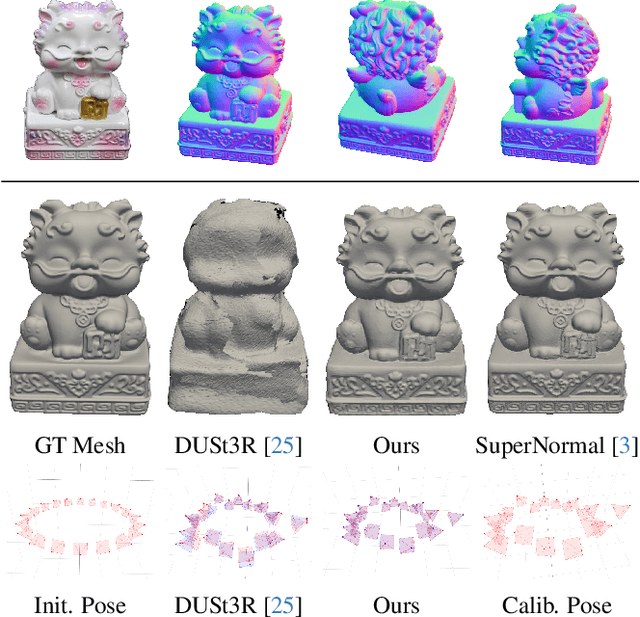
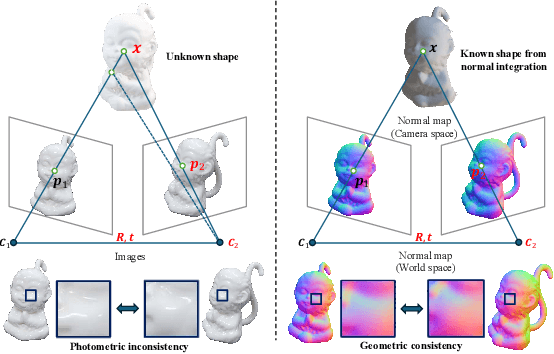
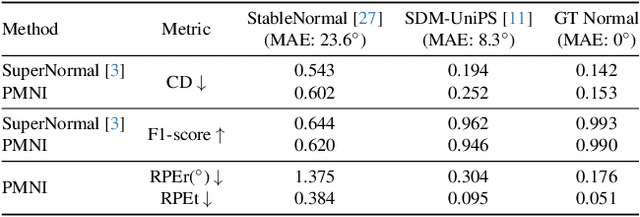
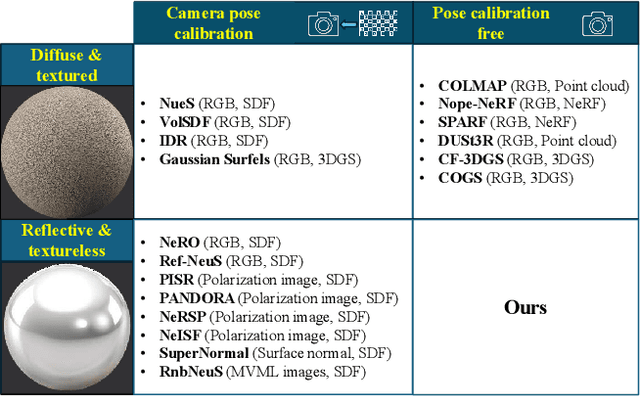
Reflective and textureless surfaces remain a challenge in multi-view 3D reconstruction. Both camera pose calibration and shape reconstruction often fail due to insufficient or unreliable cross-view visual features. To address these issues, we present PMNI (Pose-free Multi-view Normal Integration), a neural surface reconstruction method that incorporates rich geometric information by leveraging surface normal maps instead of RGB images. By enforcing geometric constraints from surface normals and multi-view shape consistency within a neural signed distance function (SDF) optimization framework, PMNI simultaneously recovers accurate camera poses and high-fidelity surface geometry. Experimental results on synthetic and real-world datasets show that our method achieves state-of-the-art performance in the reconstruction of reflective surfaces, even without reliable initial camera poses.